
Working Note №03: The Equilibrium Trap
Why Your Organization Rejects AI

Originally published at brintonbio.com. Lightly edited and brought onto Brinton Bio Working Notes as the foundational essay behind this publication.
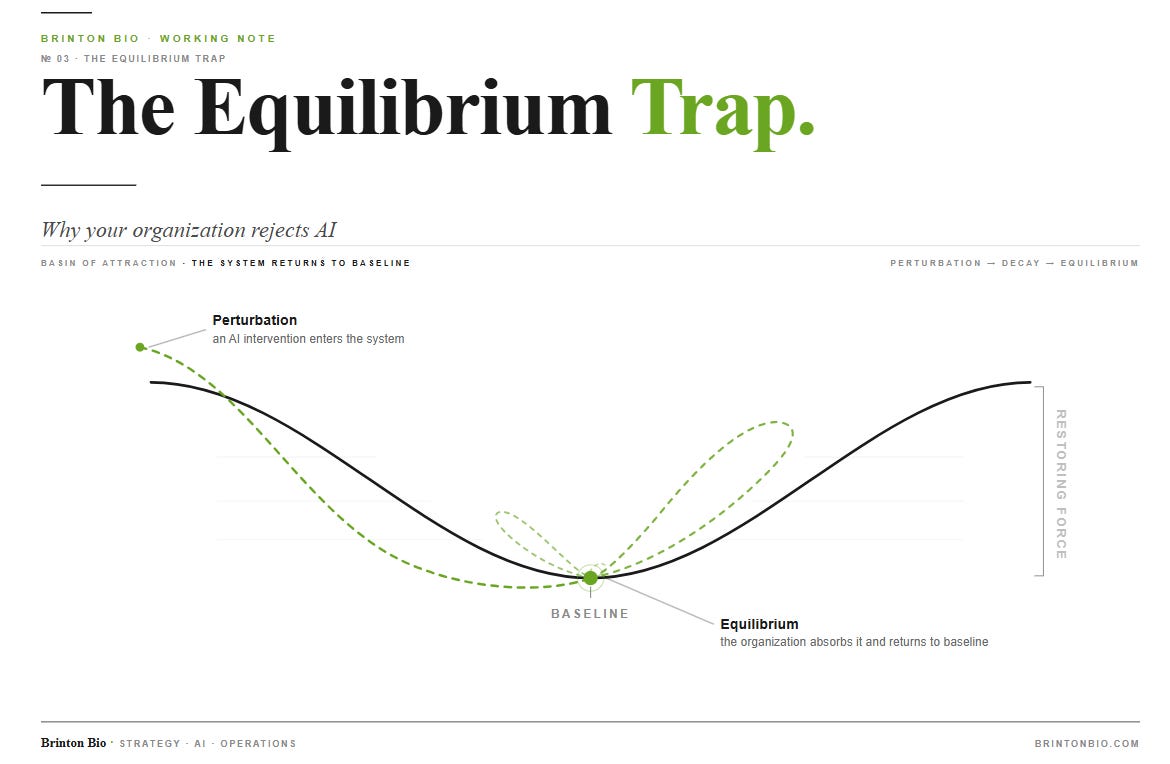
Your organization is doing exactly what stable systems do. It is defending itself against disruption.
A pilot succeeds. Leadership gets excited and authorizes expansion. IT budgets inflate while business units take cuts to fund the initiative. Six months later, the project sits in a holding pattern labeled “learning,” useful mainly as a reference point for the next attempt.
This pattern repeats everywhere. The explanations are familiar: adoption challenges, data quality issues, unclear ROI. These are symptoms. The underlying cause is structural. Organizations that successfully execute mergers, product launches, and regulatory submissions consistently struggle to turn AI pilots into lasting operational change, because AI requires a different kind of organizational capacity.
Part I. Why AI Initiatives Stall
Your Organization Is an Equilibrium
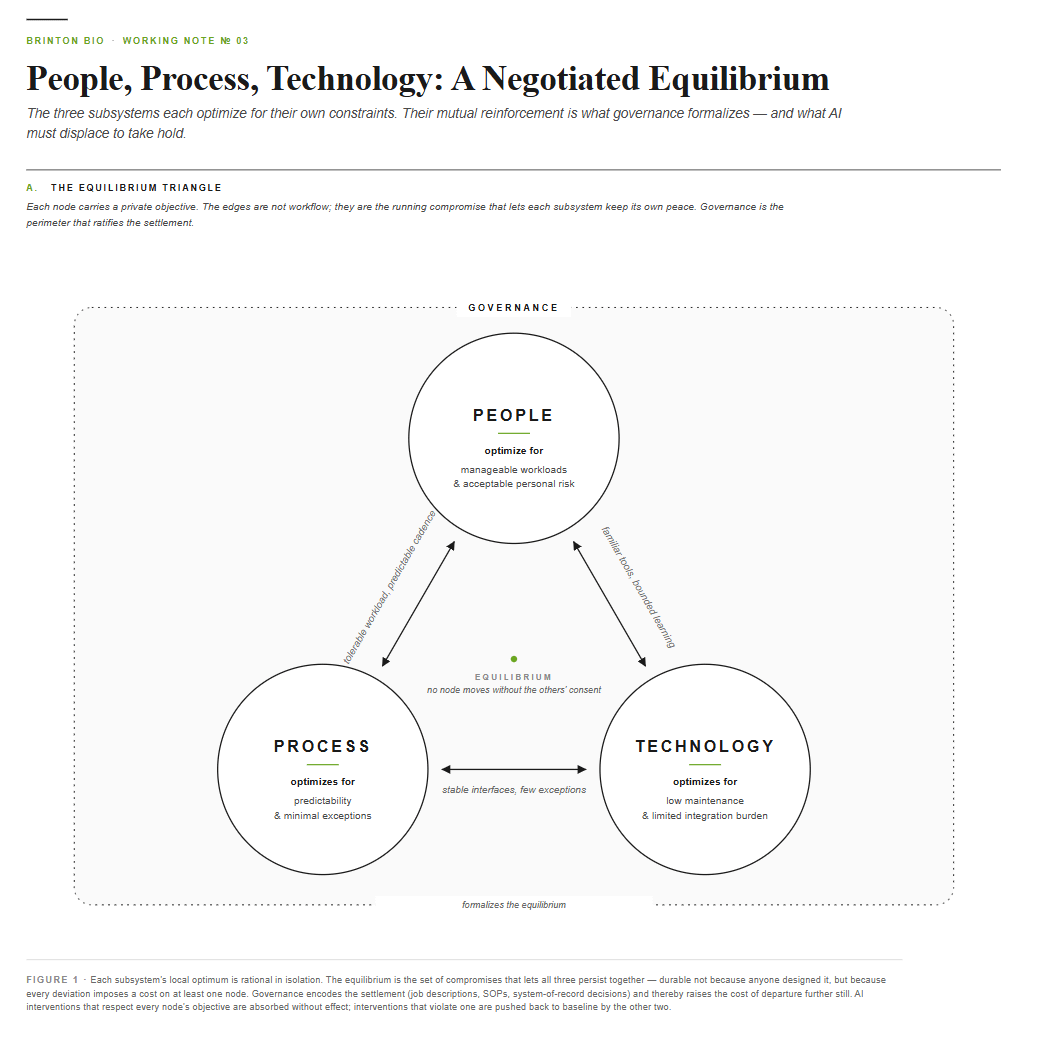
Every organization is a negotiated settlement between People, Process, and Technology. Over years, these three elements optimize against each other until they reach a stable configuration, an equilibrium where everything more or less works.
People optimize for manageable workloads and acceptable personal risk. Processes optimize for predictability and minimal exceptions. Technology optimizes for low maintenance and limited integration burden. Each accommodation reinforces the others. Game theorists call this a Nash equilibrium: no single player can improve their position by changing strategy alone.
Governance formalizes this equilibrium. Decision rights, approval thresholds, escalation paths. These define what the system will defend.
Here is what this looks like in practice. A pharma company implements a new system to accelerate regulatory submissions. The technology works. But approval thresholds remain unchanged. Exception handling stays undefined. So people keep doing what they did before, just with an extra system to click through. Cycle times hold steady.
The evidence: A unified Regulatory Information Management System (RIMS) implementation can reduce time spent searching for information by 40 percent and cut team involvement in change processes by more than 50 percent.¹ The technology delivers when organizations redesign workflows to receive it. The 48 percent of AI projects that reach production² share a common pattern: they adapted governance and workflows alongside the technology.
Why Generative AI Requires More
Previous automation waves fit into existing structures. RPA automated discrete tasks with clear boundaries. Predictive models offered recommendations that humans could accept or ignore. Simulation tools let people explore scenarios without committing.
Generative AI produces outputs that look like human judgment. Drafts, analyses, recommendations. It requires accountability structures that most organizations have yet to build. It participates in the workflow.
Ask who owns a GenAI output. Is it the person who wrote the prompt? The person who reviewed it? The vendor who built the model? When the output is wrong, who is accountable? Organizations that answer these questions explicitly capture value, and the answers unlock deployment speed, user adoption, and scalable governance.
The scale of the opportunity: 70 percent of GenAI projects that move past proof-of-concept do so because they defined governance upfront. Clear ownership, explicit error thresholds, and bounded scope.² The technology works when the organization has a place for it.
In practice. A top-20 pharmaceutical company launched generative AI initiatives in regulatory writing. Three groups moved simultaneously. One group began building a custom solution. Another group started acquiring a commercial tool. IT launched an enterprise pilot with a different vendor. Each group had legitimate rationale.
When the board demanded consolidation, ownership remained unclear. The company that moved fastest in this space, a competitor that started six months later, had a single owner and defined governance. They went live in nine months.
The Real Requirement
AI initiatives stall because they are introduced into systems with no structural place for them.
What works is redesigning how work, authority, and accountability interact, so the organization has a place for AI to operate.
This is most visible in regulated environments. Pharmacovigilance teams have local qualified persons who act as human checkpoints, interpreting context, validating outputs, maintaining trust across jurisdictions. These roles work because decision rights are explicit, escalation paths are defined, and human judgment is embedded exactly where risk concentrates.
This is an argument for building the organizational capacity to use AI alongside buying AI. The vendor sells capability. Organizational structure determines ROI.
The production gap: On average, 48 percent of AI projects make it into production, taking an average of 8 months to move from prototype to production.² Organizations that invest in readiness compress this timeline and improve success rates significantly.
Part II. The Fitness Diagnostic
Part I explains why AI initiatives stall. Part II shows where to look.
The instinct is to start with AI capabilities. What the models can do, what competitors are deploying. Start with the work instead. Most AI gets applied to work that is poorly understood or inconsistently governed. Diagnosis before deployment changes outcomes.
Make the Work Visible
Most organizations cannot accurately describe how their critical work actually gets done.
They can list process steps and name the systems involved. They can point to theoretical owners on an org chart. Describing how work actually moves, where it stalls, where it loops back, where handoffs create delays, requires mapping work as it happens, not as it is documented.
This matters because AI amplifies whatever it is applied to. Applied to a clear, well-governed workflow, it accelerates decisions and removes friction. The diagnostic ensures AI gets applied where it can succeed.
The diagnostic starts by mapping actual work. Identify roles, decision points, and handoffs. Estimate time, effort, and rework rates. Directional accuracy is enough to change decisions.
In practice. A biotech executive described his most persistent frustration: getting aligned with his direct reports required three meetings minimum. He wanted AI to summarize and automate.
When we mapped the actual workflow, the problem became obvious. There was no structured handoff. Documents went out without clear asks. Comments came back without decision criteria.
The fix required no technology. A one-page template specifying what decision was needed, what context was attached, and what “good enough” looked like. Review time dropped from three weeks to four days. Only then did AI assistance make sense, summarizing comments into decision-ready format for the final reviewer.
The Five Frictions
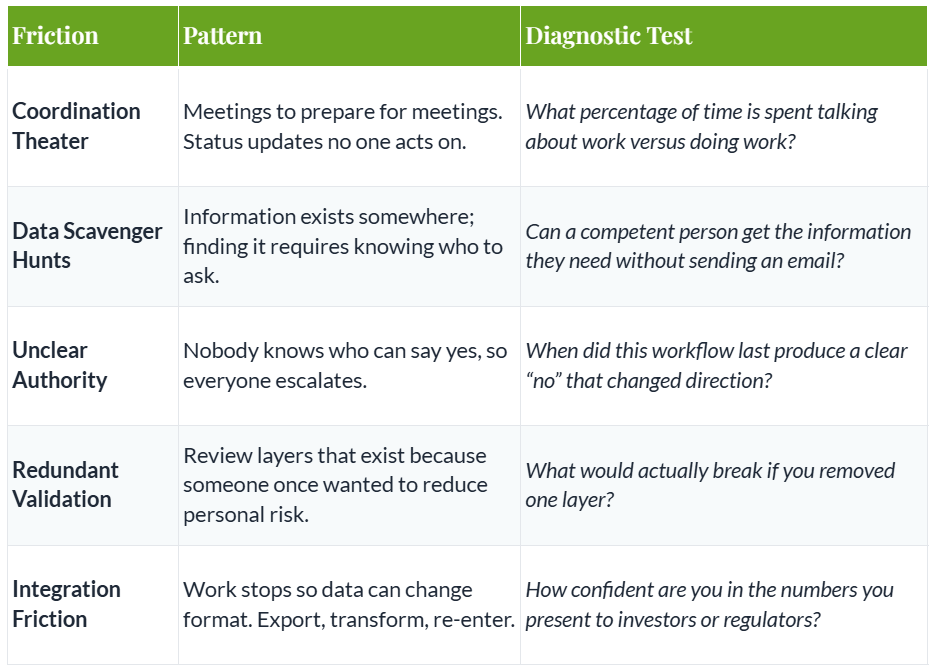
Friction is coordination cost that does not reduce risk, improve quality, or change outcomes. Five types show up repeatedly.
The coordination tax: Knowledge workers spend 57 percent of their time communicating, leaving 43 percent for focused work.⁴ More than one-third of business meetings are considered unproductive.⁵ For U.S. businesses, unproductive meetings cost an estimated $259 billion annually.⁵
The data debt: Poor data quality costs U.S. businesses an estimated $3.1 trillion annually.⁷ Data practitioners spend roughly 80 percent of their time finding, cleaning, and organizing data.⁹
These frictions cluster around specific handoffs, roles, and decision points. That is where intervention has the highest leverage.
Sort What You Find
Protective friction guards against real risk. Regulatory, safety, quality. If you can name the specific requirement it satisfies, keep it and benchmark it.
Expensive friction serves a real purpose at too high a cost. The mechanism works; the economics require redesign.
Vestigial friction solved a problem that no longer exists. It persists because removing it feels riskier than keeping it.
When nobody can remember the last time a step actually mattered, you know which category it belongs to.
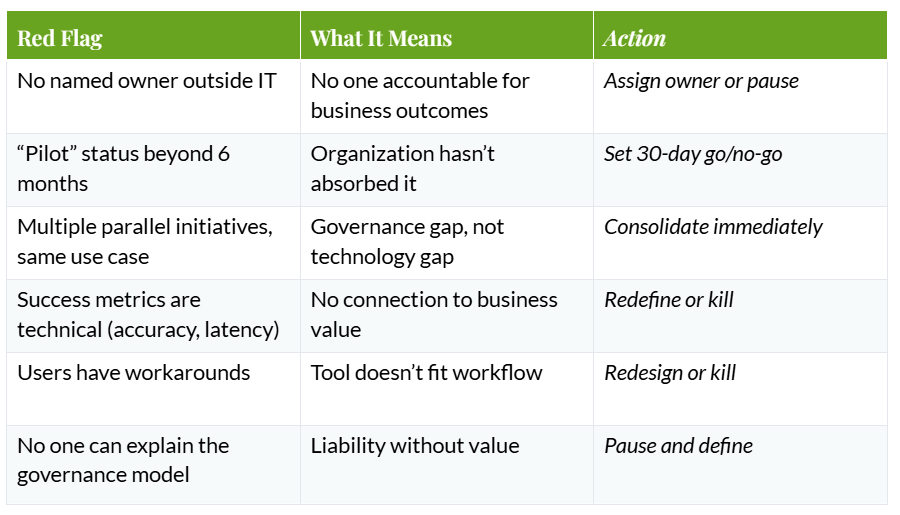
Red Flag Checklist: Kill Zombie Projects Today
Before the full diagnostic, check your current AI initiatives against these indicators.
Part III. Matching AI to Work
You now have a map of work and friction. This constrains your options, which is good. Most AI investments fail because organizations apply capabilities to work that cannot receive them.
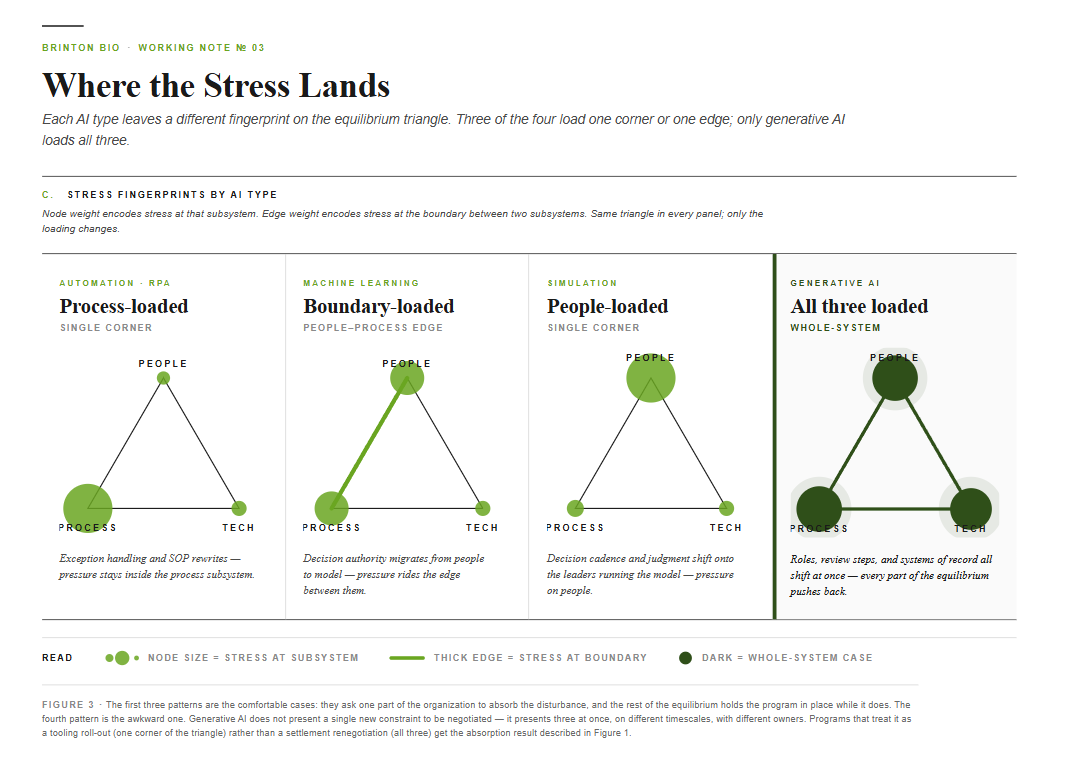
Different AI applies to different work, and each type stresses a different part of the organization. Understanding both determines success.
The AI Matching Framework
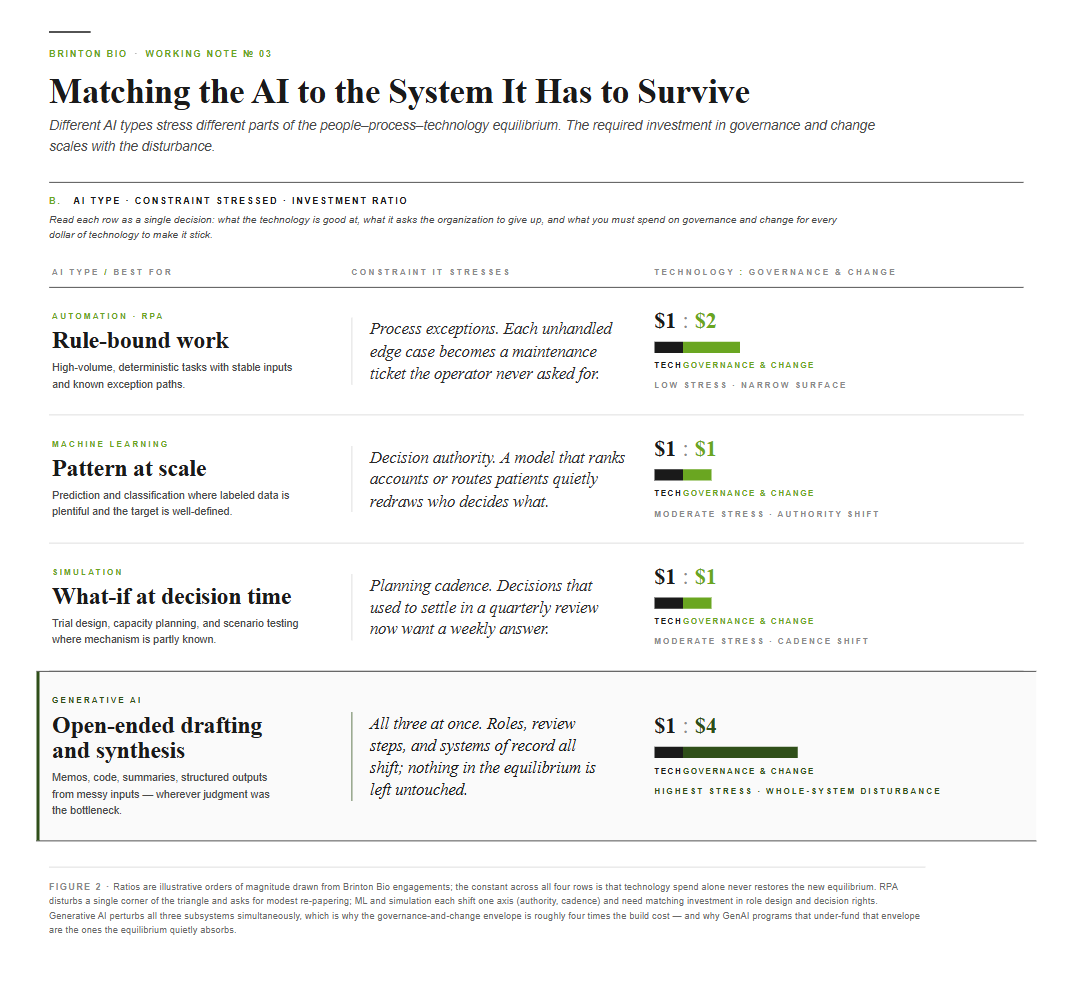
Automation: Process Clarity Required
When workflows are stable, well-documented, and exceptions are explicitly handled, automation delivers. RPA removes manual effort, cuts cycle time, and improves consistency.
The constraint is process clarity. The stress shows up as workarounds, side processes and local fixes that keep things moving while undermining intended gains.
The economics: 30 to 50 percent of RPA projects initially fail.¹⁰ Bot licensing of $5,000 to $15,000 represents only 25 to 30 percent of total cost of ownership; the remaining 70 to 75 percent goes to infrastructure, consulting, and maintenance.¹¹ Organizations that invest in process documentation before automation see 3x better outcomes.
Machine Learning: Trust Required
When work involves recognizing patterns in structured data, ML can significantly improve decision quality.
The constraint is trust. The stress shows up as overrides. People acknowledge the prediction and do what they were going to do anyway. This is rational behavior when accountability is personal.
The economics: When humans intervene in ML forecasts, they often degrade accuracy. One study showed accuracy dropping from 86 percent with ML alone to 65 percent after human override, a 21 percentage point loss.¹³ In clinical settings, override rates for decision support alerts reach 90 to 93 percent.¹⁴
The fix: Keep a scoreboard of when the model was correct. Build a cadence around reviewing predictions versus outcomes. Trust builds through demonstrated accuracy, not assertions.
Simulation: Expertise Integration Required
When outcomes depend on interactions between many variables, simulation helps explore scenarios before committing.
The constraint is expertise integration. If domain experts are not involved in building the model, they will not trust its outputs. Simulation becomes an academic exercise that informs discussion without shaping decisions.
Generative AI: Governance Required
When work requires pulling together incomplete information or producing novel outputs, GenAI applies.
The constraint is governance. GenAI produces outputs that look like human judgment, requiring structures that most organizations have not built. Who owns the prompt? Who validates the output? What error rate is acceptable? Where does escalation happen?
The stress concentrates everywhere simultaneously. People, Process, and Technology all take load. This is why GenAI requires the highest governance investment.
The economics: 70 percent of organizations attempting to scale GenAI report difficulties developing necessary governance.¹⁵ Gartner projects that 40 percent of agentic AI projects will fail by 2027 because organizations automate processes without redesigning governance.¹⁶
In practice. Two large pharmaceutical companies attempted similar GenAI deployments in regulatory writing.
The company that succeeded assigned a senior regulatory writer as product owner, someone who understood both the submission process and AI limitations. They defined explicit governance: who owns the prompt library, what error rate triggers escalation, how outputs get validated. They started with one document type, measured time savings against quality, and expanded only after demonstrating value.
Within eighteen months, they had reduced first-draft cycle time by 40 percent across their CMC organization, with the governance model now replicating to clinical regulatory.
The AI Product Owner Role
The reviewer of your current AI initiatives, the person who kills zombie projects, the owner of governance design. This is a specific role that most org charts lack.
The profile:
Domain expertise in the workflow being automated, whether regulatory, clinical, or commercial
Sufficient technical literacy to evaluate AI capabilities and limitations
Authority to make go/no-go decisions on scope and deployment
Accountability for business outcomes, measured in dollars
What this role is not:
An IT project manager
A data scientist
A “transformation lead” with dotted-line authority
A committee
If you cannot name this person for each AI initiative, you have a governance gap. Fill it before spending more on technology.
When to Sequence Organizational Redesign First
Sometimes the diagnostic reveals that friction is structural. The workflow needs redesign. Authority needs clarification. Incentives need alignment.
In these cases, organizational redesign comes first, with AI deployment sequenced after. The diagnostic identifies these situations so you invest in the right sequence.
Part IV. Designing the Intervention
By now you understand the system. You have mapped the work, classified the friction, identified stress points. What remains is intervention.
This is where most initiatives fail for the second time. The diagnosis is right. The response is incomplete. Training gets added. Processes get updated. Technology gets deployed. Each change makes sense in isolation. The system absorbs all of them and returns to equilibrium.
Intervention works when you move the system in a coordinated way.
Move People, Process, and Technology Together
These three move together or they snap back. Change one without adjusting the others and you create strain.
Durable change requires synchronized movement across all three, governed by updated rules that define what is now legitimate.
This means ensuring coherence within whatever scope you choose. If you change one workflow, change the people-process-technology configuration for that workflow together.
Why 70 percent matters: BCG’s analysis reveals that approximately 70 percent of challenges in AI implementation stem from people and process issues. Only 10 percent are attributed to AI algorithms, with 20 percent linked to technology infrastructure.²⁰ Investing in better algorithms (the 10 percent) yields less than investing in absorption capacity (the 70 percent).
Three Levers That Work
Visibility. Make performance observable at the level where work happens. When people see cycle times, rework rates, and decision latency, accountability emerges. When AI performance is visible to the people it is supposed to help, calibration happens naturally. This requires someone who understands both the business function and AI well enough to interpret what they are seeing. The AI Product Owner.
Friction redesign. Make desired behavior easy. If the AI-assisted path requires more clicks than the manual path, people will use the manual path. Redesign the friction landscape so the path of least resistance is the path you want.
Incentive alignment. Align what gets rewarded with what the system needs. If people are measured on individual output while the system needs collaborative AI use, you will get individual optimization. Make speed, quality of supervision, and effective AI use explicit performance criteria.
GenAI Governance Template
For Generative AI specifically, answer these questions before deployment.
Prompt Ownership. Who maintains and updates the prompt library? Owner: a named individual.
Output Validation. What gets reviewed before use? By whom? Owner: defined by document type.
Error Threshold. What error rate triggers escalation versus iteration? Owner: quantified threshold, for example, less than 5 percent hallucination.
Escalation Path. When something fails, who decides next steps? Owner: a named individual with authority.
Feedback Loop. How do failures reach someone who can change the design? Owner: defined cadence and channel.
Scope Boundaries. What is explicitly out of scope for AI assistance? Owner: documented and communicated.
Design this governance at the same time as build/buy/partner decisions. Waiting until after capability purchase guarantees a governance gap.
Part V. Implementation
Implementation reveals whether everything you have designed actually works.
The failure pattern is predictable. Early momentum, expanding scope, weakening governance, system reassertion. Six months later, you are back where you started with less budget and more skepticism.
Test in Real Conditions
Live workflow testing with real constraints and accountable people produces the most useful learning. Test with the people who will actually own the results.
Short cycles matter, especially for GenAI, where the goal is learning velocity. Each cycle should answer one question: what did we learn that changes what we do next?
Build the Management System Before You Need It
When consultants leave, what remains is the management system. Building it deliberately ensures continuity and sustained performance.
Explicit ownership. Every prompt, model, workflow, and decision needs a named accountable person.
Observable performance. Accuracy, adoption, rework, trust. Track these where decisions actually happen.
Compatible cadence. Build AI oversight into meetings that already exist. New rhythms that compete with existing operating rhythms lose.
Functional feedback loops. When something fails, that information must reach someone who can change the design.
Ownership drives adoption: High-performing AI organizations are characterized by senior leaders who demonstrate strong ownership and commitment.³ AI models drift as data changes; without a dedicated owner responsible for ongoing performance, the model decays until someone turns it off.²¹
Scale Through Learning
Scaling introduces new failure modes. What worked in one workflow can break when applied more broadly.
The safest path is to expand to adjacent workflows where assumptions, roles, and governance patterns are similar enough that learning transfers.
Each implementation should make the next one cheaper and faster. When implementation #5 costs less than implementation #1, you are building organizational capability.
Learning curves exist: Multi-site rollouts using standardized approaches show measurable savings. One case demonstrated a 22 percent decrease in deployment expenses by final sites.²² Cloud migration and AI modernization can take 1 to 3 years to show positive ROI.²³ Organizations that persist through the J-curve capture compounding value as each implementation makes the next one faster and cheaper.
The Investment Heuristic
For planning purposes, budget AI initiatives using this ratio.
RPA: $1 technology to $2 governance and change. Total: 3x technology cost.
ML: $1 technology to $1 governance and change. Total: 2x technology cost.
Simulation: $1 technology to $1 governance and change. Total: 2x technology cost.
GenAI: $1 technology to $4 governance and change. Total: 5x technology cost.
If your current GenAI budget allocates $2M for technology and $500K for “change management,” you are underfunded by $7.5M, or your scope should shrink by 80 percent.
The Bottom Line
Organizations that redesign themselves to use AI effectively create advantage.
The sequence matters.
Diagnose the work. Map how it actually moves.
Identify friction. Find the five types, classify by protective, expensive, or vestigial.
Match AI to work. Apply the right type to the right constraint.
Design the intervention. Move People, Process, and Technology together.
Implement with discipline. Test in real conditions, build governance, scale through learning.
This is organizational engineering. Technology is one input among several.
The equilibrium trap is real. Organizations naturally defend against change. Breaking out requires coordinated movement, and the patience to build absorption capacity before deploying capability.
The companies that win are building organizations that can use AI, and that capability compounds with every deployment.
About Brinton Bio
Brinton Bio helps life sciences organizations and their investors turn ambition into operational results.
We work at the intersection of strategy, AI, and operations, where value creation happens and where most initiatives stall.
We fix stalled AI initiatives. We help investors determine if their portfolio companies are building “innovation theater” or operational capacity. We measure the load-bearing capacity of the organization, redesign the governance, and turn “pilot” into “production” in 90 days.
Contact: andrew@brintonbio.com | brintonbio.com
References
Kalypso, “Case Study: Unified RIM Implementation for Global Medical Device Manufacturer,” 2024.
Gartner, “AI Project Success Rates and GenAI Abandonment Projections,” 2024. Via Informatica analysis.
McKinsey, “The State of AI: Global Survey 2025.”
Microsoft, “Work Trend Index: Will AI Fix Work?” 2023.
London School of Economics, “Business Meeting Productivity Research,” October 2024.
Archie, “Meeting Statistics and Cost Analysis,” 2024.
IBM, “The Cost of Poor Data Quality in the United States,” research analysis.
Gartner, “Data Quality: Best Practices for Accurate Insights,” 2024.
Pragmatic Institute, “Overcoming the 80/20 Rule in Data Science,” industry analysis.
Ernst & Young, “RPA Implementation Failure Rates,” via ActiveBatch analysis.
Blueprint Systems, “How Much Does RPA Really Cost?” infographic analysis.
Digital Teammates, “Return on Investment from RPA vs. Hidden Costs,” 2024.
SAS Blogs, “How Machine Learning is Disrupting Demand Planning,” 2018.
JMIR Medical Informatics, “Appropriateness of Alerts and Physicians’ Responses with Medication-Related Clinical Decision Support,” 2022.
McKinsey, “Charting a Path to the Data- and AI-Driven Enterprise of 2030.”
Deloitte, “Tech Trends 2026” and Gartner Agentic AI projections.
Enterprisers Project, “Robotic Process Automation by the Numbers: 14 Interesting Stats,” 2019.
NIH/PMC, “The Extent of Algorithm Aversion in Decision-Making Situations,” 2023.
International Journal of Applied Forecasting, “Forecast Value Added: A Reality Check,” Foresight Issue 29.
BCG, “AI Adoption in 2024: 74% of Companies Struggle to Achieve and Scale Value,” October 2024.
CapTech Consulting, “Why AI Fails to Deliver ROI and the Keys to Success,” 2024.
Caliber Global, “Multi-Site Retail Rollout Cost Reduction Case Study,” 2024.
CloudZero, “Cloud Computing Statistics: A 2025 Market Snapshot.”
© 2026 Brinton Bio, LLC